Most small route businesses hand off sign-up to scheduling software. That leaves a gap before the first visit and after a customer goes quiet.
By Clint Sanchez
A route business lives on a schedule. Lawn crews, pool technicians, pest control operators, and curbside bin cleaners all depend on software that knows which stop falls on which day, charges the card on file, and tells the driver where to go next.
That software has become good and inexpensive. One provider built for bin cleaning publishes a base price of $99 a month for an operator with fewer than 100 customers, rising to $149.99 for 100 to 499.
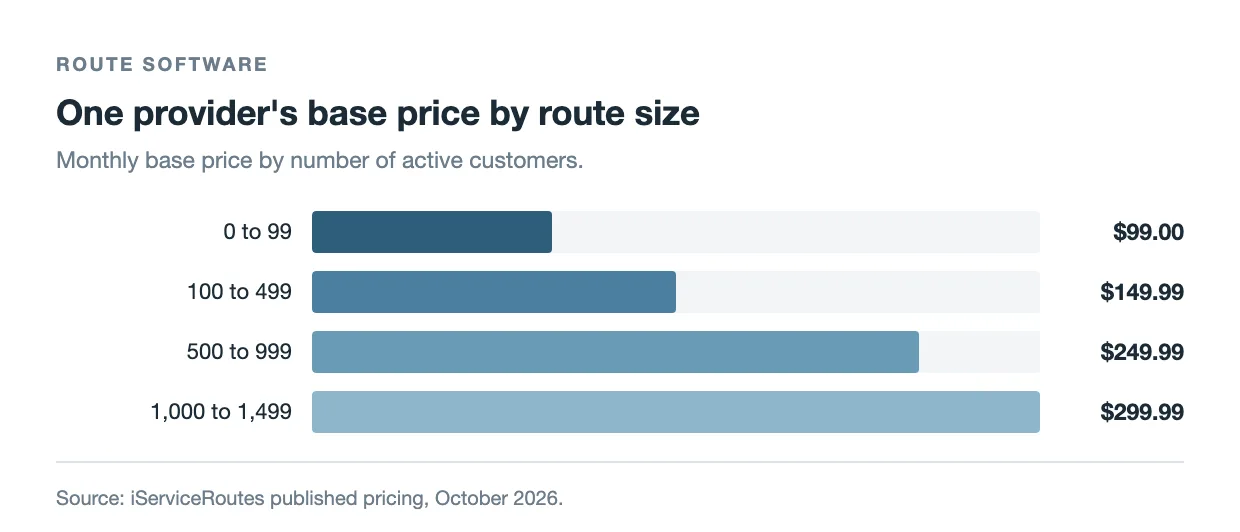
Scheduling and billing software is priced by route size.
The software is built around the customer already on the route. People who aren’t on it yet, and those who have fallen off it, sit somewhere else, and in many small operations, nowhere at all.
How signup works in practice
In October 2026, I reviewed the websites of 13 trash bin cleaning operators in at least ten states. Eight of the 13 sent the visitor to outside route software to sign up. The operator’s site made the pitch, and a button opened the software’s page to collect the address, plan,n and card.
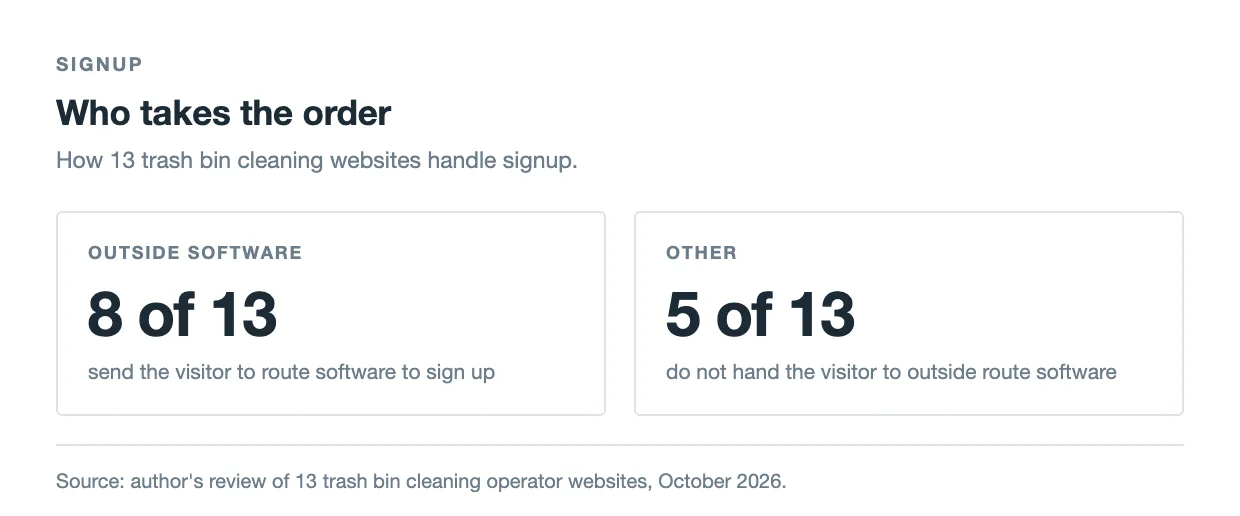
Most of the 13 operators hand the order to scheduling software.
For a one-truck business, this is a sensible arrangement. It avoids building a custom checkout, and it puts the new customer directly into the system that schedules the work.
It also defines what the business can see. A person who completes the signup becomes a record. A person who calls while the operator is washing a can, gets no answer, and never calls back never becomes one.
Three groups the schedule does not hold
There are three kinds of people a route schedule has no place for.
The first is the lead who has made contact and not signed up: a missed call, a web form, a message on social media. The second is the open quote. Homes usually buy at a published price, but homeowner associations, apartment complexes, and commercial dumpster pads get a custom number and take time to decide.
The third is the former customer. A subscriber pauses for the winter, or a card expires, and the charge fails. The stop drops off the schedule. No routing tool is designed to notice the person is gone or to ask them back.
These three groups are where a small route grows or stalls. None of them is a routing problem.
What a small operator needs to track
The answer is a customer relationship management system, usually shortened to CRM. For a business this simple, the useful version is small.
Five stages cover it: new lead, quoted, signed up, active, and paused or canceled. A handful of details per person does most of the work: the service address, the number of bins, the pickup day, the plan, where the lead came from, and any notes about the property.
The last two are most often missing, and they guide spending. Without a lead source on every record, an operator cannot tell whether yard signs or paid ads are filling the route. A fuller description of the stages and fields is set out in this guide to what a bin cleaning CRM should track.
Follow-up that does not depend on memory
The operator of a small route is on the truck most of the day. Any follow-up that depends on remembering to do it in the evening tends not to happen.
That is the case for automation. A text sent within seconds of a missed call, a reminder the day before a visit, a request for a review after a cleaning, and a spring message to customers who paused over winter are all small and easy to forget.
Automated messages follow rules, and a business that sends them is responsible for knowing them. Email is the clearest case. The Federal Trade Commission’s compliance guide for the CAN-SPAM Act says a marketing email must tell recipients how to opt out, and that a business must honor an opt-out request within 10 business days. A win-back message to former customers is marketing, and the rule applies to a one-truck operator as much as to a retailer.

Review requests have their own limits.
Review requests are the automation most likely to cross a line, because the temptation is to attach a reward.
Google does not allow that. Its Business Profile help page on getting reviews states that offering incentives, including free or discounted goods or services, in exchange for posting, changing,g or removing reviews is prohibited and treated as fake and misleading content.
Federal regulators have moved in the same direction. In August 2024, the FTC announced a final rule on fake reviews and testimonials that, among other things, prohibits businesses from providing compensation or other incentives conditioned on a review expressing a particular sentiment, and allows the agency to seek civil penalties against knowing violators.
The compliant version is simple. Ask every customer, at the same point after the service, with no reward and no filter. A system that does that automatically sits on the right side of both sets of rules, and a business owner improvising offers by text is at risk.
Two numbers worth reviewing each month
Once leads and former customers are recorded, two figures become visible that a schedule alone cannot show.
One is how many new leads became active customers. If plenty of people make contact and few sign up, the problem is follow-up or the sign-up page, not advertising. The other is how many active customers paused or canceled. A route can add ten customers in a month and still shrink.
Split by lead source, those numbers show which marketing brings customers who stay. Most small operators are currently paying for this information and not collecting it.
Limits and alternatives
The eight-of-13 figure comes from a small, non-random sample of public websites and describes how signup is presented, not how each business manages leads behind the scenes. Some operators may track every inquiry in a spreadsheet or notebook, and for a route of a few dozen customers, that can work.
Some route tools also include light lead features, and the line between scheduling software and a CRM is not fixed. The practical test is what happens when a call is missed. If the caller hears nothing back, the gap exists regardless of what the software is called.
The pattern across route businesses
Small service businesses adopt the tools that handle the work they already sell first. Tools for the work not yet sold tend to come later, often after an owner notices that the phone rang all summer and the route barely grew.
As scheduling software becomes standard across home services, the difference between operators will likely shift to what happens before the first visit. The schedule is now a solved problem. The inquiry that arrives while the owner is holding a pressure wand is not.
