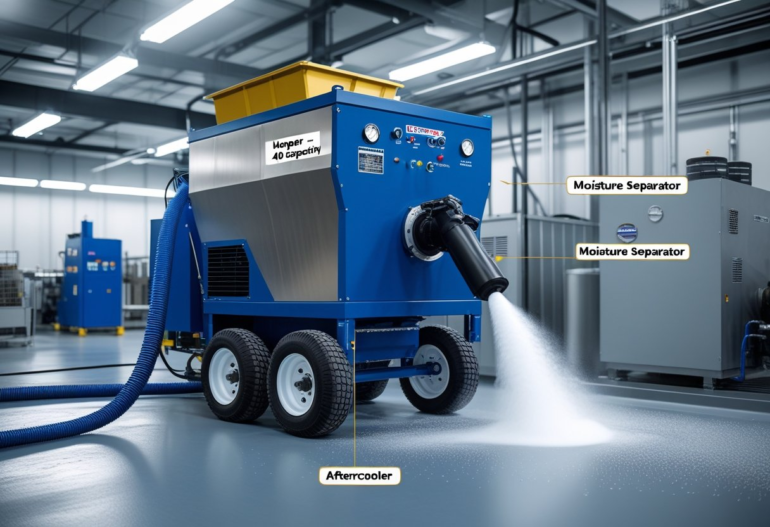
In industrial environments where surface sensitivity, residue buildup, and prolonged equipment downtime present persistent challenges, businesses are increasingly turning to dry ice blasting as a reliable cleaning alternative. Nu-Ice Dry Ice Blasting™ manufactures a wide range of dry ice blasting machines designed to address these concerns without relying on abrasive, wet, or chemical-based methods. Leveraging non-abrasive CO₂ pellet technology, Nu-Ice Blasting™ solutions support various sectors, from automotive to food processing, with equipment tailored for efficiency and precision. As a recognized provider of nu ice dry ice blasting systems, the company offers both portable and high-capacity units categorized for specific applications—each engineered to reduce wear on surfaces while streamlining cleaning operations in industrial settings.
Dry ice blasting is an industrial cleaning method that uses solid CO₂ pellets accelerated by compressed air to remove surface contaminants. The process does not rely on moisture, chemicals, or abrasives, making it ideal for sensitive equipment and environments that require non-destructive cleaning. When the dry ice pellets strike the target surface, they undergo sublimation—transforming directly from solid to gas. This phase change lifts away unwanted materials while leaving no secondary waste. Since there is no water or media residue, cleanup is significantly minimized. Dry ice blasting is used across multiple industries, including manufacturing, food processing, and automotive maintenance, due to its efficiency and surface-safe cleaning action.
Kinetic Impact
Dry ice pellets are propelled at high speeds by compressed air. Upon contact, the velocity of the pellets helps dislodge contaminants from the surface.
Thermal Shock
The extreme cold of the pellets creates a rapid temperature difference when striking a warmer surface. This causes surface contaminants to contract and lose adhesion.
Sublimation Expansion
As the dry ice pellets transition from solid to gas, they expand rapidly. This gaseous expansion helps lift particles from the surface without the need for abrasive force.
A standard dry ice blasting machine includes several essential components. The air compressor supplies the high-pressure air needed to accelerate pellets. The dry ice hopper stores and channels the dry ice pellets into the system. A metering system controls the precise flow of dry ice into the air stream, maintaining consistent application. The blasting hose and nozzle assembly delivers the pellet-air mixture to the targeted cleaning area. Each part of the system works together to ensure safe, effective, and efficient dry ice delivery across a variety of industrial cleaning tasks.
Founded in 2008, Nu-Ice Dry Ice Blasting™ is a U.S.-based manufacturer of industrial dry ice blasting equipment. All systems are engineered and assembled in the United States, with an emphasis on durability and field-repairable design. The company offers a wide range of equipment suited to various operational needs, from compact single-hose units to dual-hose configurations. Nu-Ice Blasting™ focuses on practical design principles, providing solutions for industries that require non-abrasive cleaning methods. Its manufacturing process reflects a commitment to in-house control over key components and sourcing. By offering machines with interchangeable parts and field serviceability, Nu-Ice Blasting™ supports facilities aiming to reduce downtime and streamline maintenance protocols. The company’s offerings are organized by application, allowing end-users to select equipment aligned with surface material, contamination type, and cleaning intensity. Their range of blasting machines is regularly used in sectors such as food processing, automotive, power generation, and aerospace.
Nu-Ice Blasting™ equipment incorporates several core mechanical features that enhance functionality. Each system includes a dry ice blasting gun fitted with interchangeable nozzles, allowing operators to adapt spray patterns and flow for various applications. Nozzle types are categorized for different blast pressures, surfaces, and reach requirements. Machines also come equipped with an integrated moisture separator and aftercooler. The moisture separator filters out condensation from the compressed air supply, preventing ice clumping and ensuring consistent pellet flow. The aftercooler reduces the temperature of incoming compressed air, minimizing humidity and extending machine operation stability. Together, these features support efficient dry ice delivery through the system’s hopper and metering mechanisms. Additional design considerations, such as quick-access panels and durable fittings, are integrated across the equipment line for ease of handling and on-site servicing.
Nu-Ice Blasting™ machines are designed with industrial-grade dimensions and component standards. Equipment dimensions typically range from 29″–38″ in length, 20″–24″ in width, and 35″–43″ in height, depending on the model. Weight varies by configuration, with units falling between 160 to 210 lbs when empty. The hopper capacity supports approximately 40–55 lbs of dry ice pellets, allowing for extended run times between refills. Air flow requirements span 100–250 CFM depending on nozzle type, with working pressure thresholds from 60 to 250 PSI. Dry ice consumption is typically between 1.5 to 4.0 lbs per minute, modifiable via the metering system. All models are designed for mobility and field deployment, integrating robust frame structures with pneumatic tires or anti-static casters. These baseline technical specifications are standardized across the Nu-Ice product line to meet a range of industrial cleaning environments.
The dry ice blasting process using Nu-Ice equipment begins with preparation and setup, which includes securing a compatible air compressor and loading dry ice pellets into the machine’s hopper. Operators connect the hose assembly and select the appropriate nozzle based on the cleaning context. Safety requirements involve wearing proper personal protective equipment (PPE) such as gloves, eye protection, and hearing protection. Work areas should be well-ventilated to allow for CO₂ gas dispersion. The typical workflow involves adjusting the blast pressure and dry ice feed rate, activating the compressor, and using controlled passes over the target surface. Operators monitor for consistent pellet flow and adjust parameters as needed. After blasting, the machine is shut down systematically, and routine maintenance such as purging the system and inspecting components is performed to ensure continued reliability.
Nu-Ice dry ice blasting systems are used in a wide range of industrial and commercial environments. In manufacturing and production, they help remove buildup on machinery and tooling surfaces without dismantling components. In the food processing sector, the systems are used for cleaning conveyors, ovens, and other equipment that must remain dry and residue-free to meet sanitation standards. For historical restoration and delicate surfaces, the non-abrasive nature of dry ice is suitable for removing contaminants from stone, brick, or wood without surface damage. In automotive and aerospace contexts, Nu-Ice systems are applied for cleaning engines, molds, and paint preparation. They are also used in electrical and specialty cleaning, such as transformer stations and circuit boards, due to the non-conductive, dry nature of the process. Across all applications, the equipment allows cleaning to occur in-place, minimizing disassembly and downtime. This versatility makes Nu-Ice systems adaptable to both routine maintenance and sensitive restoration efforts.
Dry ice blasting systems from Nu-Ice Blasting™ operate without introducing secondary waste, since dry ice sublimates on contact with the target surface. This eliminates the need for post-cleaning media collection or disposal. The process is non-abrasive, making it suitable for delicate surfaces and complex geometries. It is entirely dry and chemical-free, which reduces risks associated with moisture, corrosion, or solvent exposure. From an operational standpoint, the use of compressed air and solid CO₂ requires proper handling practices and ventilation to maintain a safe work environment. These systems offer a controlled method for cleaning across industrial settings, delivering nu ice dry ice blasting technology through an equipment-focused, environmentally conscious process.
Nu-Ice Blasting™ offers a range of accessories to support system flexibility and ease of use. Multiple nozzle options are available, including straight and angled variations, to accommodate different reach and cleaning patterns. Blasting hoses are designed for durability and can be selected by length or configuration. Systems integrate with industrial air compressors and may include aftercoolers and moisture separators to stabilize air supply quality. For storage and maintenance, machines are designed with easy-access panels for cleaning and servicing. Protective covers and proper dry ice handling protocols support equipment longevity and operational safety.
Frequently Asked Questions (FAQs)
What is dry ice blasting and how does it work?
Dry ice blasting is a cleaning process that uses compressed air to accelerate CO₂ pellets. When the pellets contact a surface, they sublimate and lift contaminants without leaving secondary waste.

Are Nu-Ice machines compatible with standard air systems?
Yes. Nu-Ice equipment is designed to integrate with industrial-grade compressed air sources. Specific airflow and pressure requirements depend on the machine and nozzle used.
What safety precautions should be taken?
Operators should wear PPE including gloves, eye and hearing protection. Workspaces must be well-ventilated to allow proper CO₂ gas dispersion and prevent buildup.
What infrastructure is needed to operate a system?
Users need a compatible air compressor, dry ice supply, and a work area with adequate ventilation. Electrical power is also required for system operation in most models.
How does dry ice blasting compare to abrasive methods?
Unlike abrasive blasting, dry ice blasting does not erode surfaces or introduce grit. It is suitable for delicate components and environments that require non-damaging cleaning.
What are the environmental implications of this process?
Dry ice sublimates into carbon dioxide gas, leaving no residue or chemical waste. It is considered an environmentally responsible cleaning method when used in accordance with handling guidelines.
Nu-Ice Blasting™ continues to support industrial clients with U.S.-manufactured dry ice blasting systems engineered for durability, operational control, and field serviceability. With a focus on application-specific configurations and standardized performance specifications, the company maintains a product line suited to a broad range of facility needs and sector requirements. Equipment is developed and assembled in the United States, reflecting Nu-Ice’s commitment to controlled sourcing and in-house manufacturing standards. Through consistent integration of practical features—such as interchangeable nozzles, accessible maintenance panels, and modular system components—Nu-Ice Blasting™ emphasizes usability without compromising on industrial reliability. All product specifications and system features are clearly outlined to support informed decision-making for dry ice blasting applications.