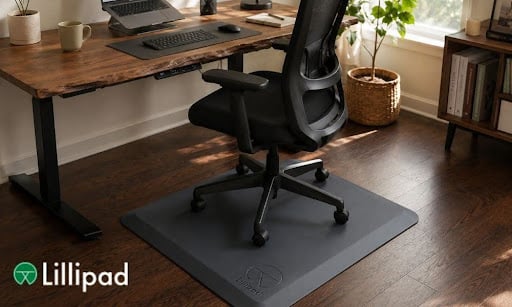
The primary purpose of a standing mat is to reduce the physical strain caused by standing on hard surfaces for extended periods. Hard floors reflect force directly back through the feet, ankles, knees, and lower back.
A mat absorbs that force before it travels up the body. The result is less fatigue, better posture, and longer comfortable standing sessions. It is a simple addition to any standing desk setup that addresses one of the most overlooked causes of daily discomfort.
Reducing Ground Reaction Force
Every time your foot contacts the floor, the floor pushes back with equal force. On a hard surface like concrete, tile, or hardwood, that force has nowhere to go. It travels straight up through the skeletal system.
A standing mat intercepts that force at the point of contact. The foam or gel core compresses slightly underfoot, which:
- Absorbs impact before it reaches the ankle joint
- Reduces cumulative pressure on the knee cartilage
- Decreases static load along the lumbar spine
- Allows the foot to spread naturally rather than compress against a rigid surface
Over a full workday, those small reductions in force add up to a significant drop in overall physical fatigue.
Activating Micro-Movements in the Legs
A firm, flat floor gives the body nothing to respond to. The muscles of the lower leg simply lock in place to maintain balance, which cuts off circulation and accelerates fatigue.
A standing mat creates a subtly unstable surface. The feet and calves respond with constant small adjustments to maintain balance. Those micro-movements:
- Keep the calf muscle pump active, which pushes blood back toward the heart
- Prevent blood from pooling in the lower legs and feet
- Reduce the heavy, swollen feeling that comes from prolonged static standing
- Engage stabilizing muscles in the ankles and feet that go dormant on hard floors
This is the mechanism that separates a proper anti-fatigue mat from simply placing a folded towel or thin rug underfoot. The surface needs enough give to trigger that response without being so soft that it causes instability.
Supporting Better Posture From the Ground Up
Posture problems often start at the feet. When the feet are uncomfortable, the body compensates by shifting weight unevenly, locking the knees, or leaning forward at the hips. Each of those compensations creates strain further up the kinetic chain.
A mat supports neutral foot positioning, which makes it easier to maintain:
- Knees soft and slightly bent rather than locked
- Hips level and not tilted forward or back
- Lower back in its natural curve rather than flattened or overarched
- Shoulders relaxed and not pulled forward to compensate for hip tension
Good posture does not come from willpower alone. It comes from having a stable, comfortable foundation underfoot. A standing mat builds that foundation.
Extending How Long You Can Stand Comfortably
One of the most practical purposes of a standing mat is simply keeping you on your feet longer. Most people who try standing at a desk without one give up within 30 to 45 minutes. The feet and lower back become uncomfortable, and sitting feels like the only relief.
With a mat, that threshold extends significantly. Users consistently report being able to stand for 60 to 90 minutes before needing a seated break. That matters because the health benefits of standing at a desk are tied directly to how much time you actually spend standing.
More time standing means:
- More calories burned throughout the workday
- Reduced pressure on the spinal discs compared to prolonged sitting
- Better energy levels in the afternoon compared to sitting all day
- Less stiffness when transitioning back to a seated position
Protecting Joint Health Over Time
The purpose of a standing mat is not just about daily comfort. It is also about protecting the joints from cumulative wear over months and years.
Cartilage in the knee and hip has limited blood supply and regenerates slowly. Repeated impact on hard surfaces accelerates cartilage breakdown over time. A mat reduces that impact load consistently across every standing session.

Key joints that benefit from cushioned support include:
- Plantar fascia: The connective tissue along the base of the foot, which is vulnerable to inflammation from hard surface standing
- Ankle joint: Absorbs vertical force with every step and weight shift
- Knee joint: Particularly the medial compartment, which bears the majority of load during standing
- Lumbar discs: Compressed by static vertical load during prolonged standing without movement
How It Fits Into a Complete Standing Desk Setup
A standing mat works best as part of a broader ergonomic approach. It handles the floor-level support, but the rest of the setup needs to work with it.
Pair your mat with:
- A desk at the correct height so elbows rest at 90 degrees
- A monitor at eye level to avoid neck flexion
- Supportive footwear with adequate arch support
- Regular alternation between sitting and standing every 20 to 30 minutes
Lillipad’s anti-fatigue standing mat is engineered to fit inside the leg frame of the foldable electric standing desk at any height. At 24 x 17 x 0.6 inches, it stays within the desk footprint without adding clutter to the workspace.
Put It to Use Every Time You Stand
Most people underestimate how much the surface beneath their feet affects the rest of their body. Sore heels lead to shifted weight. Shifted weight leads to hip imbalance. Hip imbalance leads to lower back tension. A mat interrupts that chain at the very first point of contact. That is why it is the most practical starting point for anyone building an ergonomic workspace.
If you are setting up a standing desk for the first time or looking to get more out of the one you already have, the mat is the first accessory worth adding. It costs less than any other ergonomic upgrade and delivers results from day one. The adjustment period is immediate. There is nothing to configure, calibrate, or learn.
Explore the full range of standing desk accessories by visiting our website and build a setup that supports you all day. For immediate assistance you can call or text us at (312) 834-7750