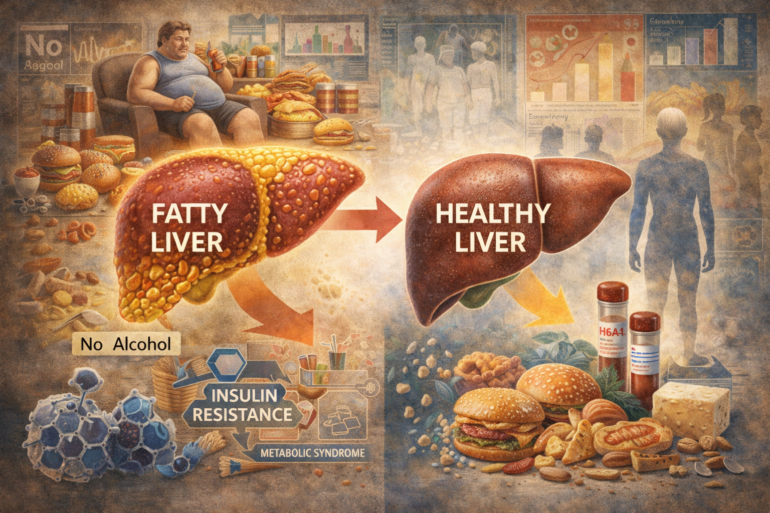
Fatty liver disease has traditionally been associated with excessive alcohol consumption. For decades, fat accumulation in the liver was viewed primarily as a toxic consequence of chronic drinking. That assumption no longer holds. In recent years, clinicians and researchers have observed a sharp rise in fatty liver disease among individuals who consume little to no alcohol. This shift has reframed the condition as a metabolic disorder rather than a behavioral one, placing non alcoholic fatty liver at the center of modern liver health discussions.
What makes this trend especially concerning is its quiet progression. Many non-drinkers with fatty liver disease show few symptoms in early stages, and routine blood tests may remain normal for years. By the time the condition is detected, metabolic dysfunction is often already established. Understanding why fatty liver disease is emerging in non-drinkers requires examining broader changes in diet, insulin signaling, and energy metabolism rather than focusing on alcohol exposure alone.
Redefining Fatty Liver Disease
Non alcoholic fatty liver disease, often abbreviated as NAFLD in medical literature, refers to excessive fat accumulation in liver cells that occurs independently of alcohol intake. It exists on a spectrum ranging from simple steatosis to more advanced inflammatory states that can progress to fibrosis, cirrhosis, and liver failure.
Historically, fatty liver in non-drinkers was considered rare. Today, it is one of the most common liver conditions worldwide. Epidemiological data published by the National Institutes of Health estimate that up to one quarter of adults globally may have some degree of non alcoholic fatty liver, with prevalence rising alongside obesity and type 2 diabetes.
This shift suggests that the liver is responding to systemic metabolic pressures rather than isolated toxic insults.
The Liver as a Metabolic Hub
The liver plays a central role in energy regulation. It manages glucose storage and release, processes fats, synthesizes cholesterol, and detoxifies metabolic byproducts. Because of this central position, the liver is highly sensitive to metabolic overload.
When energy intake consistently exceeds the body’s ability to utilize or store it safely, the liver becomes a spillover site. Excess carbohydrates and fats are converted into triglycerides and stored within liver cells. In the short term, this process is adaptive. Over time, however, persistent lipid accumulation disrupts liver function.
This explains why non alcoholic fatty liver disease is increasingly viewed as a manifestation of systemic metabolic dysfunction rather than an isolated liver disorder.
Insulin Resistance and Hepatic Fat Accumulation
Among the most important drivers of non alcoholic fatty liver is insulin resistance. When insulin signaling is impaired, the liver continues producing glucose even when energy is abundant. At the same time, insulin resistance promotes increased fat delivery to the liver from adipose tissue.
Free fatty acids released into circulation are taken up by the liver and re-esterified into triglycerides. When export mechanisms cannot keep pace, fat accumulates within hepatocytes. This process occurs regardless of alcohol intake and helps explain why fatty liver disease is so closely associated with metabolic syndrome.
Research summarized by the American Liver Foundation highlights insulin resistance as a core mechanism linking fatty liver disease with obesity, dyslipidemia, and type 2 diabetes, even in individuals who do not drink alcohol.
The Role of Modern Diets
Dietary patterns have shifted dramatically over the past century, and these changes have placed new demands on the liver. Diets high in refined carbohydrates, added sugars, and ultra-processed foods promote rapid glucose absorption and repeated insulin spikes.
Fructose, in particular, has drawn attention in liver research. Unlike glucose, fructose is primarily metabolized in the liver. High fructose intake increases de novo lipogenesis, the process by which the liver converts carbohydrates into fat. This pathway bypasses many regulatory steps, making it especially potent in driving hepatic fat accumulation.
Studies discussed by Harvard Health Publishing have noted that high intake of sugar-sweetened beverages is strongly associated with non alcoholic fatty liver, independent of total calorie intake or alcohol use.
Why Non-Drinkers Are Not Protected
One of the most persistent misconceptions about fatty liver disease is that abstaining from alcohol provides protection. While avoiding alcohol eliminates one source of liver stress, it does not address metabolic factors that drive fat accumulation.
Non-drinkers may still experience chronic insulin stimulation, sedentary behavior, sleep disruption, and stress, all of which influence liver metabolism. In this context, the liver responds to energy overload rather than ethanol toxicity.
This helps explain why fatty liver disease is now being diagnosed in younger populations, including adolescents, many of whom have never consumed alcohol.
Inflammation and Disease Progression
Simple fat accumulation in the liver does not always lead to severe disease. However, in some individuals, hepatic fat triggers inflammatory signaling. This inflammatory state can damage liver cells and promote fibrosis.
The transition from simple steatosis to inflammatory liver disease appears to be influenced by oxidative stress, mitochondrial dysfunction, and immune activation. These processes are closely tied to systemic metabolic health.
Low-grade inflammation originating in adipose tissue or the gut may further exacerbate liver injury, reinforcing the idea that non alcoholic fatty liver is part of a broader metabolic network rather than a standalone condition.
The Silent Nature of Liver Dysfunction
One of the most challenging aspects of non alcoholic fatty liver disease is its lack of early symptoms. The liver has a remarkable capacity to compensate, allowing dysfunction to progress unnoticed.

Many individuals with fatty liver disease have normal liver enzyme levels, leading to delayed diagnosis. Imaging studies or incidental findings often reveal the condition during evaluation for unrelated issues.
This silent progression underscores the importance of understanding non alcoholic fatty liver as a systemic metabolic pattern rather than waiting for overt liver damage to appear.
Liver Health and Metabolic Flexibility
Emerging research suggests that metabolic flexibility plays a role in liver fat regulation. When the body can efficiently switch between fuel sources, the liver is less likely to become overloaded with fat.
Focusing predominantly on glucose metabolism while having difficulty with fat oxidation can really strain the liver’s pathways. This imbalance may cause triglycerides to build up and hinder lipid export. Fortunately, there are fantastic educational resources on metabolic health, like those from Dr. Berg. They emphasize the liver’s role as a crucial indicator of metabolic balance, going beyond simple detoxification. It’s exciting to learn how we can support our liver and overall wellness!
Rethinking Liver Disease in the Modern Context
The rise of fatty liver disease among non-drinkers challenges outdated narratives about liver health. It suggests that modern environments, characterized by constant food availability, reduced physical activity, and chronic metabolic stress, are reshaping disease patterns.
This shift has implications for screening, prevention, and public health messaging. Focusing solely on alcohol consumption overlooks the primary drivers affecting a growing portion of the population.
Recognizing non alcoholic fatty liver as an emerging metabolic pattern allows for earlier identification and more comprehensive intervention strategies.
Non alcoholic fatty liver disease represents a convergence point where diet, insulin signaling, and lifestyle factors intersect. Its increasing prevalence among non-drinkers highlights the limitations of traditional liver disease models that focus narrowly on alcohol exposure.
As research continues to evolve, the liver is increasingly viewed as a metabolic sensor rather than a passive victim of excess. Fat accumulation within liver cells reflects broader systemic pressures that extend beyond individual behavior.
Understanding non alcoholic fatty liver through this lens shifts the conversation from blame to biology. It emphasizes the need to address underlying metabolic patterns rather than treating liver fat as an isolated abnormality. In doing so, it opens the door to more effective prevention strategies and a more accurate understanding of liver health in the modern world.